In high-performing teams, the courage to risk and fail isn’t a threat. It’s a signal. A signal that the team is growing, experimenting, and engaged in solving real problems.
But in many organizations, the opposite is true. Risk is met with hesitation, blame, or bureaucracy. People hold back their ideas. Frontline employees don’t speak up. Leaders play it safe. And slowly, innovation dies, not from lack of talent, but from fear.
Risk is not reckless. It’s a foundational behavior of learning organizations. And it becomes possible—not dangerous—when trust, interdependence, empathy, and genuineness are strong.
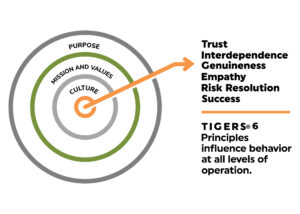
In fact, research held during the TIGERS Workforce Behavioral Profile™ validation process shows that two principles—interdependence andsuccess—are highly correlated with all the others. When interdependence is high, people are more likely to take risks. When success is shared, people stay committed through discomfort and iteration.
Together, these create cultures where people solve problems at the root cause, not the surface symptom. And that’s where transformation begins.
Why teams lack the courage to risk
In environments where trust is weak, risk is terrifying. Mistakes are punished. Accountability is replaced by blame. And conflict escalates to the top because peer-level dialogue never matures.
In these settings:
Employees hide errors instead of addressing them
Innovation is stifled by fear of criticism
Leaders become firefighters instead of visionaries
Without risk-taking, learning slows. And when learning slows, growth flatlines.
But when risk is normalized, a new behavior emerges. Ownership. And that’s the soil for scalable leadership at every level.
What the courage to risk looks like
In TIGERS-based cultures, risk isn’t about gambling. It’s about planning boldly and adjusting wisely. It’s rooted in strong feedback loops and smart collaboration.
Real risk is:
Involving frontline employees in decision-making to improve execution
Giving teams permission to fail fast—and document what was learned
Training people to resolve conflict with peers instead of escalating it upward
Asking, “What could we try?” before saying, “That won’t work here”
This is how cultures evolve. Not by avoiding mistakes, but by extracting their value.
Risk Frees Leaders to Lead
When empathy, genuineness, and interdependence are strong, risk no longer creates chaos—it reveals clarity.
Leaders no longer have to micromanage every decision or defuse every tension. Instead, they become growth enablers because their teams can handle conflict and resolution at the source.
That’s how:
Conflict becomes collaboration
Setbacks become learning
Performance becomes self-correcting
The result? Less time spent managing drama, and more time building strategy.
Building Risk Resilience Across the Team
Want your team to take smarter risks? Start by reinforcing these behaviors:
Model your own learning from mistakes
Celebrate not just outcomes, but intelligent effort
Encourage experimentation tied to clear goals
Ask what went right and what was learned when things don’t go as planned
When risk is treated as an investment in innovation, employees rise to meet it.
Final thought — the courage to risk builds sustainable success
Risk doesn’t erode success. It builds it.
Because teams that never risk will never evolve. But teams that risk with skill, empathy, and purpose? They outperform, outgrow, and outlast their competition.
When you build a culture where people aren’t afraid to try, fail, adjust, and own their impact—you’re no longer just managing a team. You’re leading a learning organization.
And that’s where lasting success lives.
Want to Turn Risk into Results?
Explore our Leadership Toolkit or the Power of Transformational Feedback course.
You’ll learn:
How to teach risk as a team skill
Tools to build frontline trust and accountability
Feedback loops that fuel innovation—not fear
Learn more here. Because every breakthrough your team needs is on the other side of a risk you’ve made safe to take.
Copyright TIGERS Success Series, Inc. by Claudia Craven
About TIGERS Success Series
The TIGERS 6 Principles emerged from Business, Education and Psychology Group Dynamic Research. Independently evaluated twice for reliability and validity, the TIGERS 6 Principles offer a comprehensive system for collaborative workforce and leadership development. Visit TIGERS Learning Center here.

 In high-performing teams, the courage to risk and fail isn’t a threat. It’s a signal. A signal that the team is growing, experimenting, and engaged in solving real problems.