
 To better grasp how to resolve conflict, let’s head to XYZ Company, a manufacturing company with 80 employees.
Will Kirk and Andy learn how to resolve conflict?
Kirk, who has been with XYZ for 20 years, is a senior factory manager. He oversees the operations floor, supervises factory workers, and ensures that the factory runs smoothly. Andy, on the other hand, is the head of sales and marketing. He pushes XYZ’s products into the market and gives his yearly, monthly, and daily projections to Kirk, who then projects raw materials requirements and submits the same to the purchasing department.
Kirk and Andy are the old-timers in XYZ. Both are jovial but hardly get along in the workplace. You see, Andy’s goal is to sell as much as possible and he thinks that the production department (Kirk’s kingdom), should keep up. But then Kirk is inclined to take things slow because he’s very detailed and wants to produce high-quality output with as little to zero spoilage, rejects, and scraps. Voila! Conflict.
Will Stanley and Jim learn how to resolve conflict?
On the opposite wing is the customer service department. While most of their services have already been outsourced overseas, Stanley and Jim head the 10-person team for domestic distributors. Their main task is logistics, but what they do daily is make sure that the supply chain (from raw materials to production to distributor to retail outlets) runs efficiently. A tall order.
Stanley and Jim are extremely good at what they do. In fact, one manager quipped that they “make dreams come true” because they get things done right and quick, all the time. However, while their stakeholders (distributors, employees, and other stakeholders) respect them, Stanley and Jim are constantly at each other’s throats simply because their managerial styles differ.
Stanley is the proverbial, harsh schoolmarm who adheres to rules no matter how unreasonable, while Jim is your typical neighborhood sweetheart who everyone wants to befriend. Both are great at what they do and both get the job done. But Stanley feels Jim doesn’t take things seriously. Jim, on the other hand, thinks that he has to “clean up and PR” after Stanley since everyone (clients included) is scared of him. As a result, everyone feels the tension in the office. Something as trivial can escalate into a verbal brawl between the two.
The types of conflict
There are two types of conflict – DIRECT and LATENT.
Direct conflict happens when there is a clear difference in opinion. This may happen when a person’s point of view is different from someone else’s or when one’s needs are at odds with another. (Kirk and Andy).
The second type, latent conflict, involves situations where bad feelings develop over time creating a block to productivity and relationships. This kind of conflict happens for several reasons. It may be because someone didn’t handle a situation well, or a team member lacks a skill set, or in this case, personality differences. (Stanley and Jim)
Nobody wants conflict. Believe it or not, even war mongers don’t like it. It bruises egos and burns bridges, and can negatively impact morale in the workplace. At some point, everyone avoids conflict at work. Reasons can always be classified under the following:
- It’s simply too risky – too much political risk that could damage a project, a proposal, or even a career.
- It’s too personal – people feel that the issue isn’t work-related so they simply let it go and lick their wounds in private.
- It’s just not worth the hassle – because it’s simply too hard and unpleasant. It could also be because the person lacks confidence or control to manage the situation.
As you may have experienced so yourself in your workplace, the inclination to avoid conflict is high when the conflict is latent. On the other hand, direct conflicts can easily erupt into an open situation.
Can these types of conflicts be resolved?
Absolutely! In my 30 years as a collaborative work culture consultant for group dynamics and organization development, I have yet to come across an organization with zero conflict. Conflict fluctuates in workplace relationships. And to be candid, I look forward to seeing conflict because it indicates the potential for growth. If I see no conflict during change in an organization, I’d suspect the company to be dead or dying!
When people work together, the emotional exchange of ideas and insights is a natural occurrence. But at the end of the tunnel, employees and members at every level must continue working despite the doubts and conflicts. While some conflicts may resolve through short dialogues and putting group behavior norms in order, other situations may need more work. They require effort, a genuine willingness to reevaluate the issue, and an authentic commitment to working things out in the long term (with both parties committed to the outcome).
Conflict resolution is easily a favorite module in my TIGERS Genuineness Communicator course. If this is something you feel could help your workplace, find out more HERE.
What does it take to settle conflict effectively?
Rule #1: You gotta be a tiger
I say this in jest with a straight-face … because conflict resolution is not for the faint hearted. A good conflict handler must have:
- Courage – The process of resolving conflict often involves misinterpretation and hurt feelings. It takes courage to be calm and deliberate.
- THE ABILITY TO THINK QUICKLY – Being prepared is half the battle. But being prepared also means anticipating that your resolution may not pan out as you expect.
- THE ABILITY TO BALANCE INTERESTS – No matter how offensive the other side is, a good conflict handler must care about the other person and his/her point of view while looking after his/her own needs.
- Patience – In many conflict scenarios, one must adopt the mind-set of temporary ambiguity. This means that one party (or both) may have to work with disagreement until an acceptable solution is arrived at. It may be resolved it your favor. But it may also be resolved otherwise. In such case, a good conflict handler must also be able to…
- COMPROMISE – The conflict may be resolved… but not in your favor. If so, you must be willing to compromise and accept the solution.
Rule #2: Know when to surrender and when to fight
We all want to hold our ground. But ask yourself, is it worth it? An easy way to avoid conflict is to evaluate how much interest you have in the outcome versus that of the other party. Know where you are in this table.
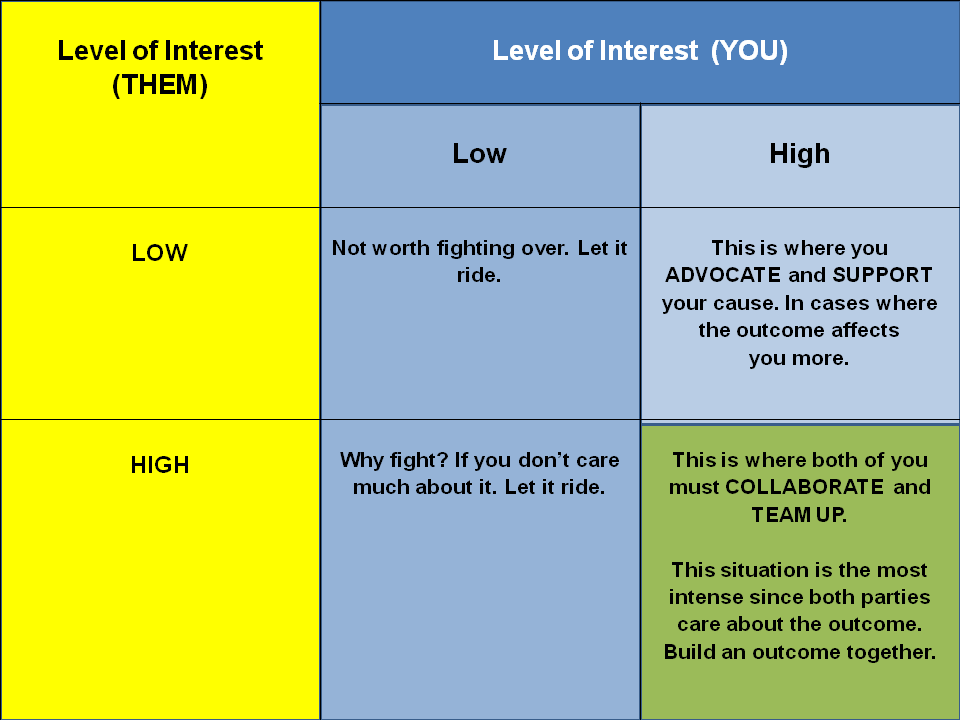
Rule #3: It’s all about balance.
It all comes down to squaring out being “cooperative” versus “advocating” for your cause. Strike a balance between being passive and aggressive. The challenge is to find middle ground. Words play a huge role. For instance:
Passive phrases sound like:
- Whatever
- Doesn’t matter
- Its ok… whatever is ok
Aggressive phrases sound like:
- What’s wrong with you?
- You always …
- You hardly/never …
- I want this from you – OR ELSE!
Assertive phrases sound like:
- This doesn’t seem to work for both of us. It’s not working for me because … and its not working for you because… What works for me is this… What would work for you?
- The next time something like this comes up, can we agree to continue by letting each other know we are tired and need reschedule the conversation for the next day …?
- These are (established facts and numbers) we are getting. You mentioned that … but what we need is … Let’s see if we can come up with a workable solution.
Now take a minute to think through all the misunderstandings you have had with others over the past six months. How were you part of the conflict? What could you have done better?
Bottom line – it takes two to tango. Achieving a good collaborative understanding and way forward is a lovely dance if you are willing to learn the steps.
Care to dig deeper into the conversation of how to resolve conflict?
- TIGERS Among Us Book Club
- White Paper – How to Build a Principled and Collaborative Work Culture
- TIGERS Genuineness Micro Training
(Part 1 of 3 — To be continued: How to Resolve Conflict Part 2 of 3. Stay tuned!)
Copyright TIGERS Success Series, Inc. By Dianne Crampton
About TIGERS Success Series
TIGERS provides a comprehensive, multi-pronged and robust system for improving your workforce behavior, work culture, profitability and project management and team leadership success. We offer licensing and certification in the use of TIGERS resources to build high performance collaborative teams and leaders.
 We specialize in building cooperation among employees and collaboration between departments for profitable agile, high performance team outcomes. Scaled to grow as your organization and leadership performance improves, our proprietary TIGERS Workforce Behavior Profile, Micro-Training technology and group facilitation methods result in your high performance team outcomes and change management success. We also license and certify elite internal and external consultants and project managers to use our resources for similar outcomes.