
 I believe values and team development principles such as trust, interdependence, genuineness, empathy, risk and success (TIGERS®) build strong teams and leaders. This is especially true when behaviors that support these business values are readily seen in the workplace. We know when this happens, employee home life is also impacted in a favorable way.
Nearly three-quarters (73 percent) of employed U.S. adults who take part in environmental and social responsibility efforts at work are more likely to make sustainable choices at home as a result, according to the fourth annual Gibbs & Soell Sense & Sustainability® Study. Despite persistent skepticism among the general public about corporate America’s commitment to “going green,“ the majority of employed adults are interested in learning what companies are doing in terms of sustainability and “going green” (74 percent) and wish their own company or employer engaged in more sustainability business practices, including “going green” or social responsibility initiatives (68 percent).
“improving the health of the environment by implementing more sustainable business practices and/or offering environmentally-friendly products or services.”
Gibbs & Soell, a global business communications firm with expertise in sustainability consulting and employee engagement for the advanced manufacturing, agribusiness and food, financial services, and home and building markets, commissioned Harris Interactive® to conduct the fourth edition of the Sense & Sustainability Study®. Harris Interactive conducted the online poll between February 28 and March 4, 2013 among 2,219 U.S. adults, including 1,028 adults who are employed full-time and/or part-time.
“There is a lot of research around motivating consumers to make more sustainable purchases from the perspective of product marketing, so we decided to investigate the opportunity to influence them in the workplace,” said Ron Loch, principal and managing director, sustainability consulting, Gibbs & Soell. “We found that the ripple effect of engaging employees in sustainability activities means they are more likely to practice sustainability at home and encourage neighbors to do the same. However, too few employers seem to be taking advantage of this opportunity to create green consumers. Two-thirds of employees (67 percent) could not identify who at their workplace is responsible for sustainability, or said no one is responsible.”
Key findings include the following:
- Sustainability-engaged employees express a mutual relationship between sustainable activities at work and the choices they make at home. They also want to see their company and others more actively involved in sustainability initiatives. Nearly three-quarters of employees who take part in sustainability initiatives at work are more likely to make sustainable choices at home as a result (73 percent) and say they wish their employer engaged in more sustainable business practices (73 percent). 80 percent of sustainability-engaged employees report encouraging others to make sustainable choices – meaning “going green” or engaging in social responsibility initiatives.
- Many employed adults reveal a gap in or express uncertainty about their own company’s practices. Two-thirds (67 percent) of employees are not sure whether there is anyone at their company who is responsible for sustainability, or they say no one is responsible for sustainability at work. Nearly one-fifth (19 percent) of employees say their company does not promote sustainability at all.
- Among employed adults, there is a strong link between knowledge gained about a company’s sustainability efforts and intent to purchase from that company. Three-quarters (75 percent) of employed adults say they would be more likely to buy a company’s products or services if they learned it was making a great effort to adopt environmentally-conscious practices.
- The general public continues to doubt corporate America’s commitment to sustainability. But, despite their skepticism, most U.S. adults and employees want to learn about green business initiatives. Only 21 percent of U.S. adults believe that a majority of businesses (“most,” “almost all,” or “all”) are committed to “going green” – defined as “improving the health of the environment by implementing more sustainable business practices and/or offering environmentally-friendly products or services.” However, most Americans (72 percent) and employed adults (74 percent) express interest in learning what companies are doing in terms of sustainability and “going green.”
Gibbs & Soell has a long-established communications record in sustainability consulting, corporate social responsibility, and successfully launching and guiding the growth of green products, technologies and practices. The firm counsels a growing roster of clients to help them align sustainability to their corporate strategies, produce compelling sustainability reports, and engage key stakeholders, including employees, in constructive dialogue.
Copyright TIGERS Success Series by Dianne Crampton
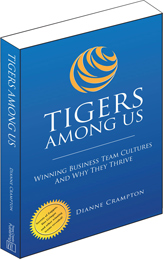 About TIGERS Success Series
We believe that when employees come to work on Monday morning with a sense of thrill and excitement to see their coworkers and to dive into another successful week that the business they work for probably rocks! We help leaders build those teams and work cultures. And, we certify consultants to offer the TIGERS Team Development Success System to their clients, too.

It's so important to love what we do each and every day. It's exciting to be in a workplace hat encourages teamwork and individuality.
I also think leadership is a quality for teams:one has to be a leader at one time or another, even if on a team.
Perhaps what is needed is a grass roots effort from employees to get a green movement going in their organizations. One or more "green minded" employees can volunteer to get the ball rolling with the hopes that leaders will be inspired to make more formalized policies. If the impetus is from the "rank and file" there should be a greater awareness of the organization's sustainability efforts.
Great information! I love your posts – good leaders = better team
leadership is always key its tough to do your job right when your executives are not on the right page
I believe, Joyce, that when kindness and respect are displayed in the workplace the individuality within a team is secured.
Tony, that is a wonderful idea. I think when affinity groups like this start in companies it does a couple of things for the business. People learn than giving back to community is part of the organizational value system. So work becomes a much bigger footprint in their lives and in the community. Second, it is a rich training ground for leadership and planning training development. This gives employees the training ground to lead projects and initiatives prior to assuming critical job roles. So practice becomes an internal opportunity rather than having employees quit to assume opportunity elsewhere. Third, it is a strong succession leadership strategy through community influence. Thanks for commenting!
I agree, Joanne. Good insight. Your post reminds me of the Geese in Flight example of synergy.
I agree, Joanne. Good insight. Your post reminds me of the Geese in Flight example of synergy.
I think Jeffrey, this is why there is such high turnover. Values clash is a key consideration.
Thanks, Regina. What I appreciate most about your visits is your career frame of reference. TIGERS was formed in part from group dynamic research in psychology so as a psychologist your insights are invaluable.
Thanks, Regina. What I appreciate most about your visits is your career frame of reference. TIGERS was formed in part from group dynamic research in psychology so as a psychologist your insights are invaluable.